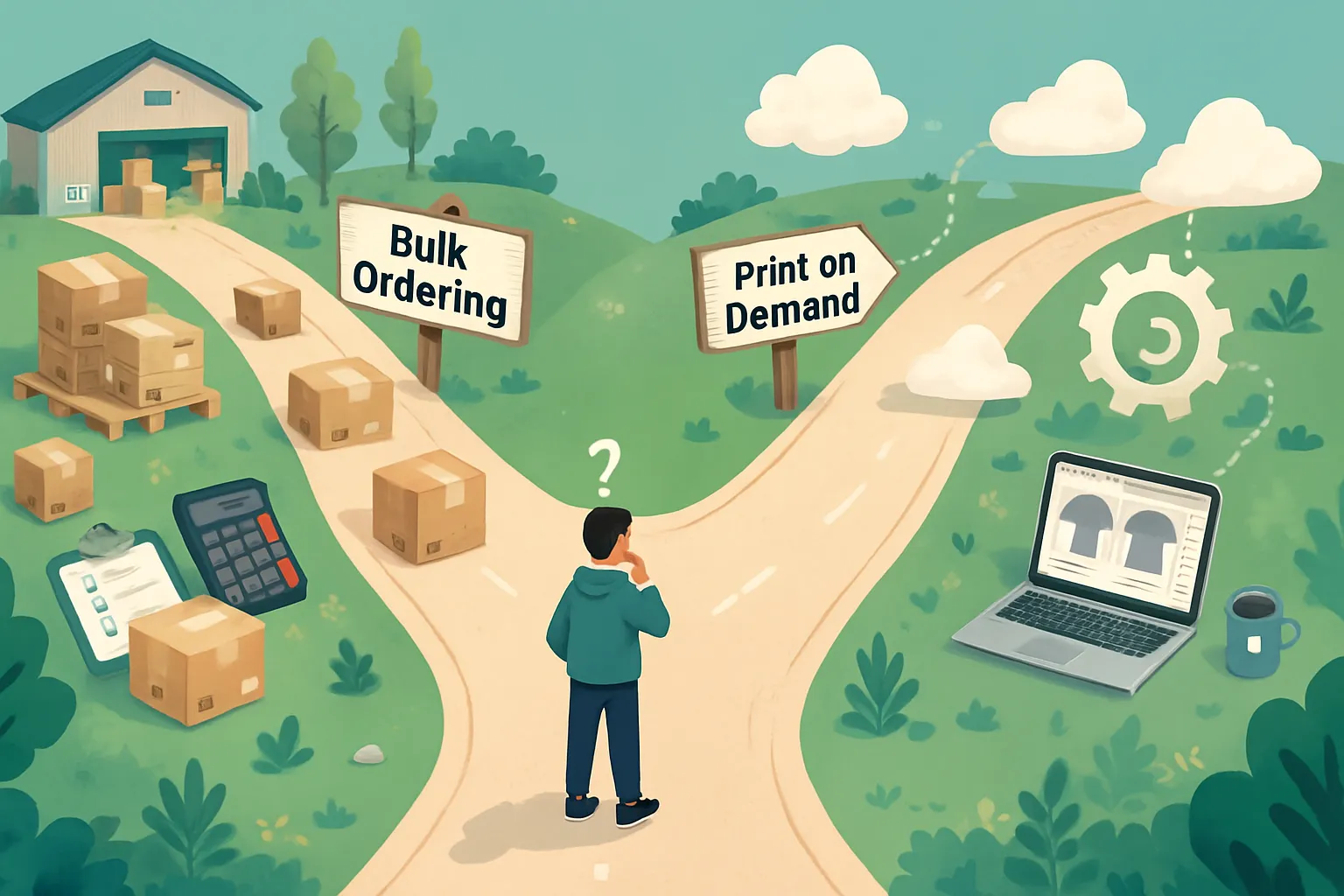
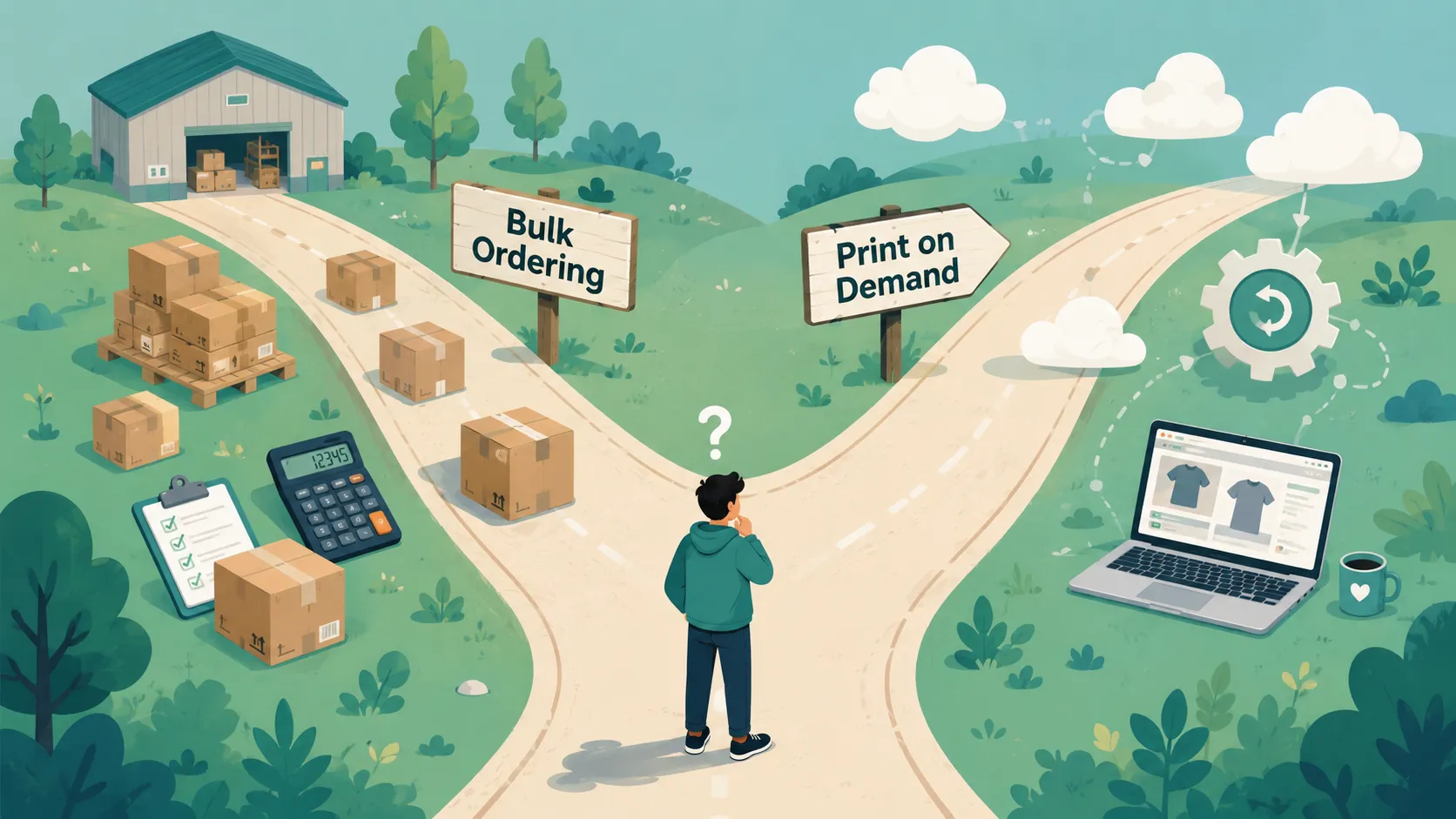
If you're ready to start monetizing your art through merchandise, you're facing a fundamental fork in the road: Should you order in bulk from a manufacturer, or should you use a print-on-demand service?
I've consulted with dozens of artists, illustrators, and content creators over the past few years, and this question comes up in almost every conversation. The answer isn't one-size-fits-all, but understanding the real-world trade-offs can save you thousands of dollars and countless hours of frustration.
Let me break down both models, show you the hidden costs most creators miss, and help you figure out which path makes sense for your specific situation.
The Traditional Route: Bulk Ordering (MOQ Manufacturing)
This is the old-school approach: You find a manufacturer, send them your designs, and order a minimum quantity (usually 50-500 units per design). You pay upfront, receive a shipment of physical inventory, and then you're responsible for storage, packing, and shipping each order yourself.
The Advantages:
- Lower unit cost: If you're ordering 500 T-shirts, your per-shirt cost might be $8-12, compared to $15-18 on POD platforms.
- Full control over quality: You can touch and approve samples before committing.
- Higher profit margins (in theory): With lower production costs, you could make more per sale.
The Hidden Costs and Risks:
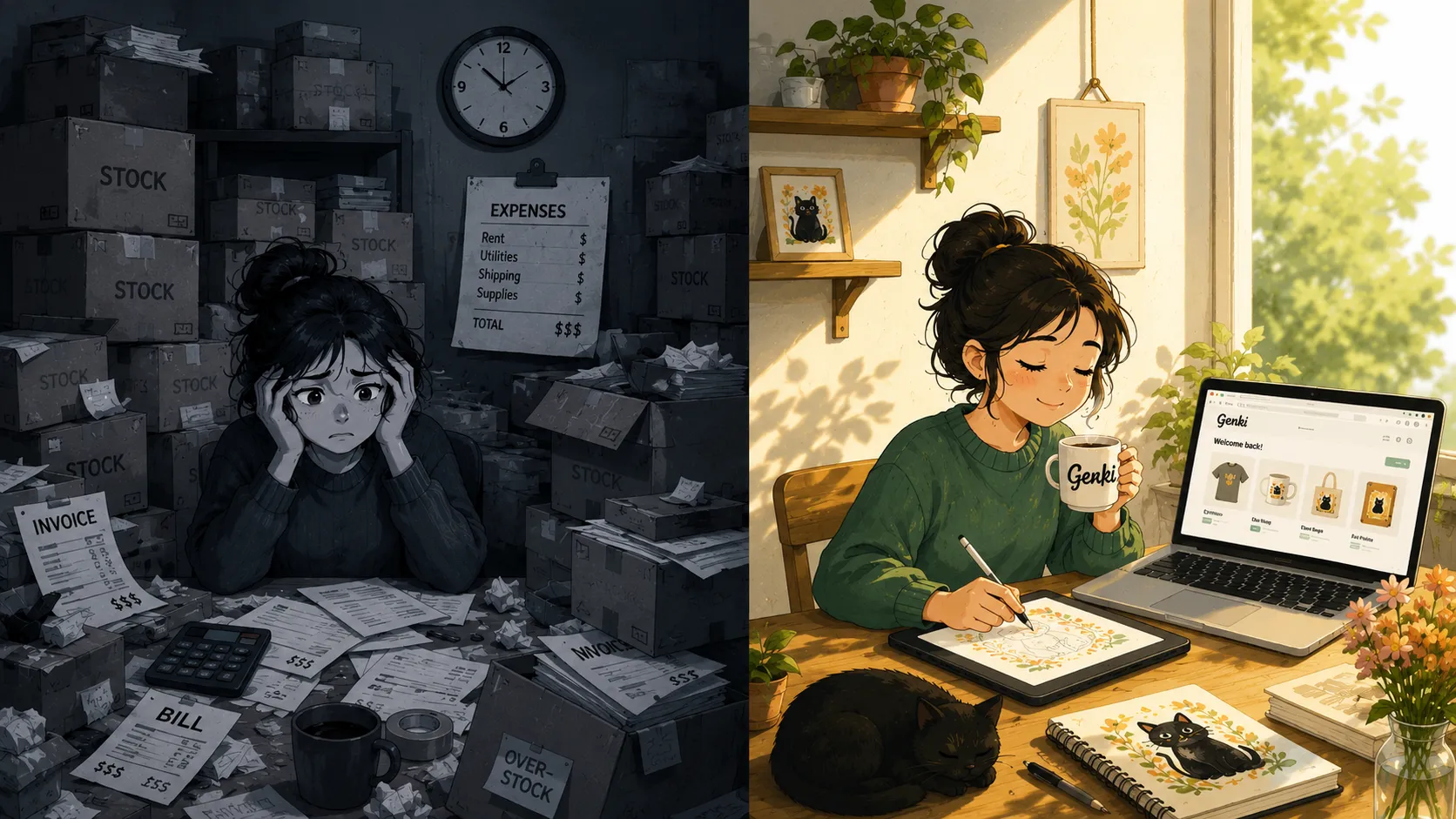
- Massive upfront investment: You might need $2,000-$5,000 just to get started (and that's for a small run).
- Inventory risk: What if your design doesn't sell? You're stuck with boxes of unsold merch gathering dust.
- Storage and logistics: Where are you keeping 500 T-shirts? Your garage? A storage unit ($100+/month)?
- Time drain: You become a full-time warehouse manager—printing labels, driving to the post office, handling customer service for lost packages.
- Design commitment: Once you print 500 shirts, you can't easily pivot to a new design that's trending.
Bulk ordering usually works best for established creators with proven bestsellers, a dedicated fanbase, and the capital to invest upfront. If you know you can sell 200+ units of a specific design, bulk ordering can maximize profit.
The Modern Route: Print-on-Demand (POD)
With POD, you upload your designs to a platform, and they only produce an item after a customer orders it. You never touch inventory. The platform handles production, shipping, and customer service.
The Advantages:
- Zero upfront cost: You don't pay anything until someone buys.
- Zero inventory risk: If a design flops, you haven't lost money on unsold stock.
- Infinite variety: You can offer 50 different designs across 20 product types without any extra work.
- Hands-off fulfillment: You never pack a box or visit a post office.
- Global reach: Most POD platforms have production facilities worldwide, so international shipping is faster and cheaper.
- Flexibility to test: You can launch a design on Monday, see if it sells, and pivot by Friday.
The Trade-Offs:
- Higher per-unit cost: You might pay $18-22 for a T-shirt that costs $10 in bulk.
- Lower profit margins per sale: Your markup is smaller (though your total profit can be higher because you're not eating unsold inventory costs).
- Less control over production: You're trusting the platform's quality standards.
And POD works better for new creators testing the market, artists who want passive income without logistics, and anyone who values time freedom over maximizing per-unit profit.
The Real-World Math: A Side-by-Side Example
Let's say you're an illustrator launching your first merch line. You want to offer T-shirts with your art.
| Factor | Bulk Ordering (500 units) | Print-on-Deman |
|---|
| Upfront Cost | $4,000 (500 shirts × $8) | $0 |
| Cost Per Sale | $8 (production) + $3 (shipping labor/materials) = $11 | $18 (all-in) |
| Retail Price | $30 | $30 |
| Profit Per Sale | $19 | $12 |
| Break-Even Point | Need to sell ~210 shirts to cover initial $4,000 | Profitable from sale 1 |
| Risk if Only 50 Sell | Lost $3,050 + have 450 shirts in storage | Made $600 profit, zero waste |
| Time Spent on Fulfillment | ~100 hours (packing, shipping, customer service) | 0 hours |
But the kicker is, if you value your time at even $20/hour, those 100 hours of fulfillment work cost you $2,000 in opportunity cost. Suddenly, the "lower unit cost" of bulk ordering doesn't look so cheap.
When Print-on-Demand Makes the Most Sense
Based on what I've seen work with real creators, POD is the smarter choice if:
- You're launching your first merch line and don't have sales data yet.
- You want to offer variety (multiple designs, multiple product types) without financial risk.
- You value time freedom and don't want merch to become a second full-time job.
- You want to test designs quickly and double down on what sells.
- You're building passive income and want truly hands-off revenue.
The Next Evolution: Automated POD Platforms
Here's where the POD model gets even more powerful. Traditional POD platforms still require manual work. You have to design each product mockup, adjust the sizing for every item type, and upload them one by one.
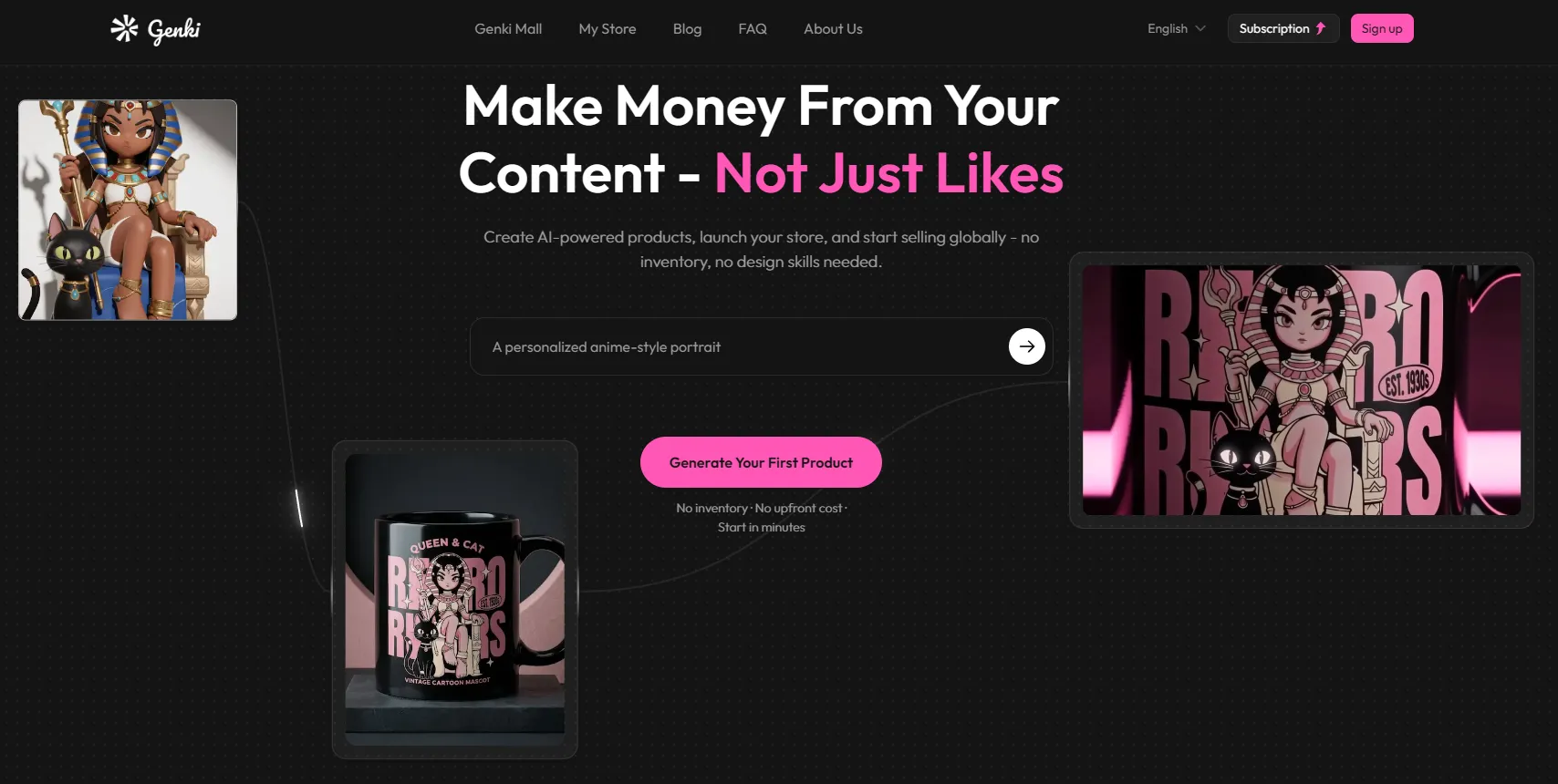
But newer automated POD platforms are changing the game. Take Genki, for example. It's built specifically for artists and creators who want to sell custom merch without the design busywork:
- Automatic product designs: You upload your original artwork once, and Genki's system automatically creates optimized designs for T-shirts, mugs, phone cases, tote bags, hoodies, and more. What used to take days now takes minutes.
- Dual sales channels: You can either open a storefront directly on Genki, or sync your auto-designed products to your existing Shopify or Etsy store. Orders flow to one backend.
- Full-service fulfillment: They handle production, global shipping, and customer service. You literally never touch a package.
This addresses the biggest weakness of traditional POD - the manual setup labor, while keeping all the advantages (zero risk, zero inventory, infinite variety).
My Recommendation: Start with POD, Graduate to Bulk (Maybe)
If you're reading this and haven't launched merch yet, start with print-on-demand. It removes all the barriers that stop most creators from ever getting started.
You can start with POD to:
- Test which designs your audience actually wants to buy.
- Experiment with different product types (you might be surprised, but sometimes stickers outsell shirts).
- Build a baseline of passive income without gambling your savings.
Then, if you have 1-2 designs that consistently sell 100+ units per month, that's when you can consider switching those specific bestsellers to bulk ordering for higher margins.
But don't make the mistake of bulk ordering before you have data. I've seen too many talented artists lose thousands on inventory that never moved.
The Bottom Line
Bulk ordering is for creators who already know what sells and want to maximize profit per unit.
Print-on-demand is for creators who want to test, scale, and build passive income without financial risk or logistical headaches.
And automated POD platforms like Genki are for creators who want all the benefits of print-on-demand without spending hours formatting designs.
The choice depends on where you are in your journey. But if you're just starting? Go with the option that lets you create art instead of managing a warehouse.
Ready to see how your art looks on auto-designed merch? You can try on Genki to explore the product options and the magical process!
Related readings: